

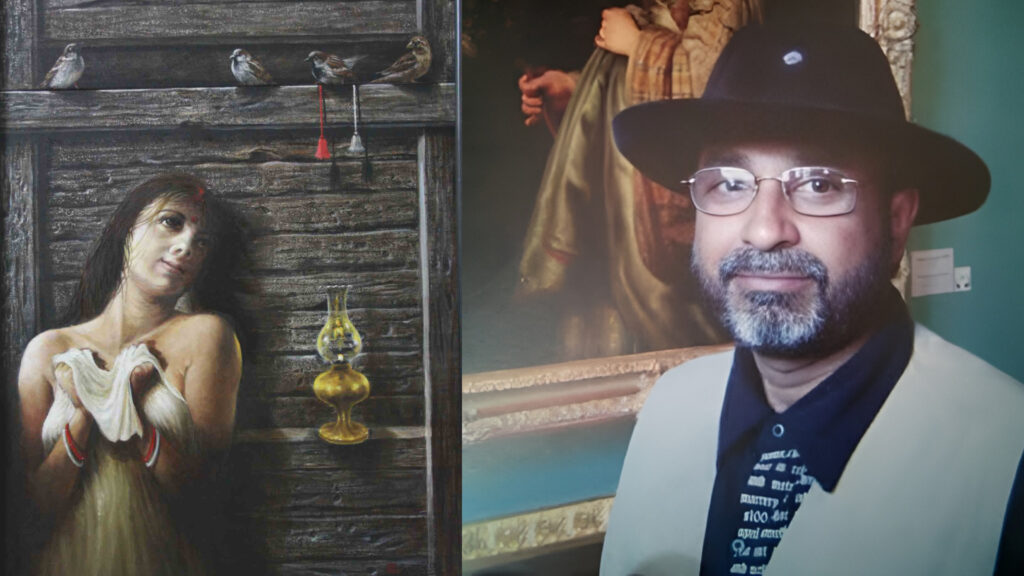
There is a trap that recognition sets for artists. It tells them, in the subtlest possible way, that they have arrived — that the work they are doing is good, has been ratified as good, and should therefore continue in approximately the same direction. The trap is comfortable, and many artists stay in it for the rest of their careers.
Partha Bhattacharjee was awarded the President of India’s silver plaque for the best work of 2000-2001 by the All India Fine Arts and Crafts Society. He was recognised, celebrated, and entirely legitimate as one of India’s significant contemporary artists. He was also, immediately afterward, restlessly looking for what came next.
The Award and What It Recognised
The award came for the Devi Series — the body of oil paintings in which Partha deployed Trompe-l’oeil to reveal ordinary Indian women as manifestations of the divine. These were paintings of considerable technical sophistication and genuine philosophical ambition, built on more than thirty years of developing the skills required to make them. The Trompe-l’oeil technique, mastered through years of producing commissioned copies of European masters — Rembrandt, Renoir, Vermeer, Titian — had become, in the Devi Series, the vehicle for a deeply Indian spiritual vision.
The award, in other words, recognised exactly what Partha had intended: the meeting of European technical mastery and Indian philosophical depth. The question that immediately followed, for him, was: what does that meeting produce next?
The 2000s: Deepening and Widening
The decade after the award saw the Devi Series continue to evolve — giving rise to the Sekal-Ekal (Then and Now) Series, which placed the divine feminine in conversation with historical time, and the Krishna Series, which brought the divine masculine into dialogue with the feminine. The Illusion Series pushed the Trompe-l’oeil investigation to its formal limits, asking directly: what is real, what is painted, and does the difference matter? These were not the works of an artist resting in recognition. They were the works of someone who understood that recognition is just a milestone, not a destination.
The 2010s: A Conscious Departure
As the 2010s arrived, Partha made a decision that was, for someone in his position, genuinely bold. He turned deliberately away from the European academic tradition that had shaped his training and toward Indian miniature forms, adding three-dimensional materials to his canvases and incorporating the Indian miniature idiom into his compositions. The Mahakal Series, Rural Series and Jesus Series of this decade carried his moral and social convictions — his call for peace, equality, and justice — with a directness that his earlier, more meditative work had expressed through spiritual metaphor.
These were paintings with a conscience. They were also a significant stylistic departure from the work that had earned him the award. He made them anyway.
The Final Departure: Folk Art and Compromised Vision
Then came 2017 and the cerebral attack that damaged his sight. Rather than stop, he adapted — moving to dry pastel and mixed media on paper and turning fully toward the Madhubani, Warli, Gond, and Bengal Patachitra traditions he had been absorbing in India’s remote villages for years. The result was the Companion Series, Migrant Worker Series, Continuation of Rural Series, and Durga Series — works that many who have seen them consider the most personally authentic of his entire career.
The artist who refused to rest on his laurels after the President’s award was the same artist who refused to stop after losing much of his sight. Partha Bhattacharjee painted until his death in 2025, leaving behind a body of work that moves restlessly across decades, mediums, and styles while remaining absolutely consistent in its core conviction. For collectors and admirers of Indian fine art with genuine cultural depth and biographical authenticity, the later series of artist Partha Bhattacharjee are some of the finest Indian contemporary art that anyone can witness and own.