

Most interview preparation is built on the same implicit promise: if you just see enough questions, you’ll be ready. The result is an arms race of ever-larger question banks — bigger lists, more categories, higher counts. We think that model is quietly wrong, and we built an engineering-reference product around a different one.
The trouble with the flashcard model
The flashcard model assumes the bottleneck is exposure — that failing an interview means you ran out of questions to memorise. For experienced engineers, that is rarely what happens. They fail because they can recite an answer without being able to defend it.
A candidate who can describe a caching layer but cannot explain what happens when the cache and the database disagree has memorised a fact, not internalised a concept. In a real interview, the follow-up — “what would you do when this fails in production?” — is where the conversation is actually won or lost. Volume does nothing for that. A thousand more flashcards produce a candidate who recognises more questions and understands no more of them.
A reference desk, not a deck
The alternative is to treat preparation the way engineers already treat their actual work: as a reference library you reason from, not a script you recite.
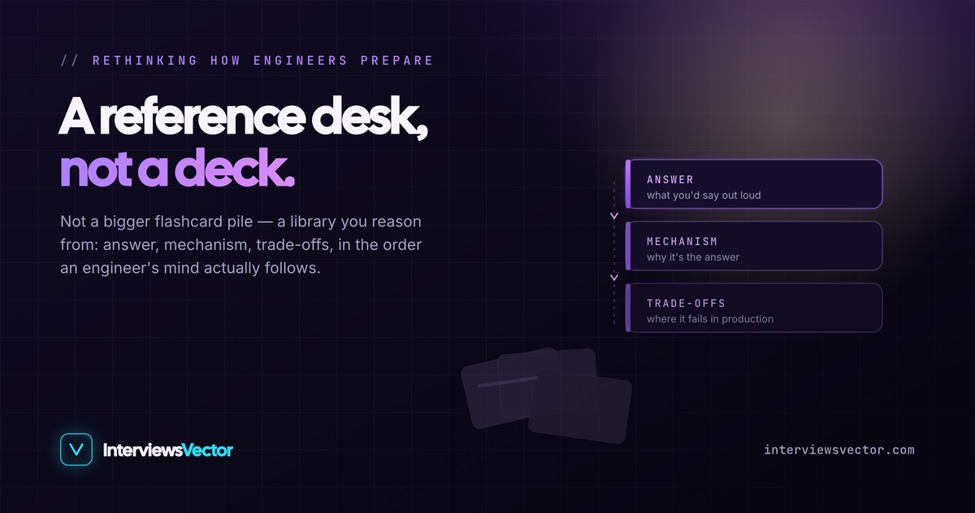
Think about how a good engineer learns something on the job. They don’t memorise it; they look it up, understand the mechanism, see how it connects to what they already know, and build judgment they can apply to the next, different problem. Preparation modelled on that looks less like a flashcard deck and more like an engineering reference desk — organised so you can move from “what’s the direct answer?” to “why is it the answer?” to “what are the trade-offs and failure modes?” in the same reading order an engineer’s mind actually follows.
That is the core design principle: lead with the answer you’d give out loud, then unfold into the mechanism and the production-oriented follow-ups. Someone revising the night before an interview gets the concise answer immediately. Someone with an afternoon can keep going into the depth. The same material serves both, because it’s arranged as reference, not as a quiz.
Why breadth of understanding beats breadth of questions
A reference library is judged by how well it helps you reason, not by how many entries it has. So the goal shifts from more questions to better-connected understanding.
This is why the material spans not just isolated questions but the surrounding engineering context — from quick-reference cheatsheets you can scan in the last hour before an interview, to deep material on distributed systems for when you need to genuinely understand replication and consistency rather than recognise them. The bet is that an engineer who understands the mechanism can answer a question they’ve never seen, while an engineer who memorised a thousand answers is stranded the moment the interviewer changes the wording.
The discipline behind it
A reference library is only trustworthy if it’s accurate, so one rule shapes everything: no fabricated proof. No invented statistics about how often a question is asked, no manufactured claims about which companies use what, no confident numbers nobody can source. Interview preparation is already noisy with authoritative-sounding figures that fall apart under scrutiny. A reference you can actually rely on earns trust through precise trade-offs, honest version context, and reasoning you can check against primary documentation — not through impressive-looking stats.
That restraint occasionally makes the content harder to write. It also makes it the kind of thing you can stake an interview on.
The bottom line
The flashcard model treats preparation as a memory problem and answers it with volume. We treat it as an understanding problem and answer it with structure — a reference desk for how senior engineers actually think, arranged so the answer, the mechanism, and the trade-offs live in one place. The questions were never the point. Building the judgment to reason through them was.