

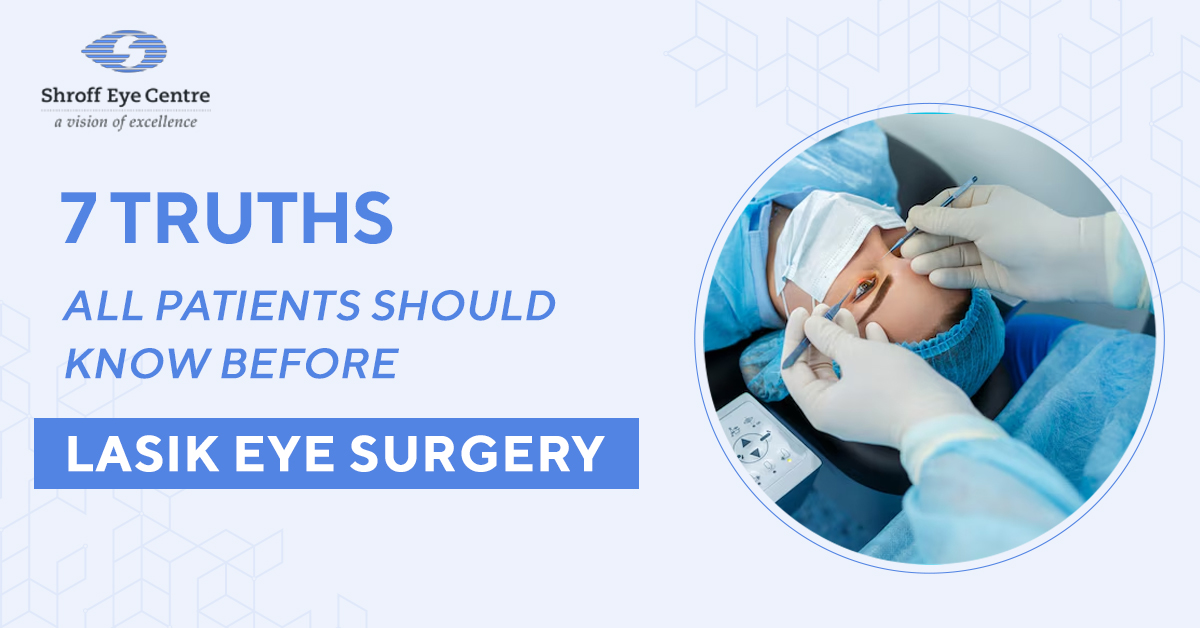
Shroff Eye Centre’s Dr Rushad Shroff Shares what he tells his own patients
Every day patients ask us “Can you remove my specs with LASIK?”
The answer is not often what they expect, and sometimes don’t want to hear, but patients are always happy to hear the nuances and appreciate the fact that they were informed. Here are the seven truths every patient should know before walking into any refractive surgery eye consultation – let’s start with the ones that genuinely surprise people.
All refractive surgeries such as LASIK,SILK,PRK, Streamlight and ICL aim to improve your vision and remove dependence on specs. There is a lot of marketing jargon and a lot of information and patients are often confused with all the terms. Before you make a decision, here are seven things Dr Rushad Shroff, of Delhi’s famous Shroff Eye Centre, believes every patient should understand.
1. LASIK is one of many types of refractive surgery
In India, LASIK has become an umbrella term which patients use for any procedure that will help them get rid of their glasses. But the world of refractive surgery has expanded dramatically. Today, we have LASIK, SILK, PRK, Streamlight, SMILE, CLEAR and ICL (Implantable Collamer Lens). While these terms are not as popularly known as “LASIK”, each procedure has its own strengths, ideal patient profile, and technology. LASIK itself is either done with a blade (blade LASIK) or without a blade (blade-less or Femto LASIK).
Choosing the right procedure for your eyes is what a good eye surgeon helps you do.
2. There isn’t One single “Best” refractive procedure for everyone
Many patients arrive having already decided they want LASIK- there is so much marketing around this word, it’s to be expected. After evaluation however, not all patients are good candidates for LASIK. Some are better suited to SILK, some to PRK and some to ICL.
It’s important to understand that if LASIK was good for your friend’s eyes, it may not be what is “best” for you. What is “best” for you is decided after a proper consultation and detailed evaluation of your eyes and your visual needs. And sometimes, that recommendation may be to not do LASIK at all or wait and watch. So do not take your doctor’s refusal personally; If someone refuses to do a surgery- it’s for your safety.
3. If you’re told you can’t get LASIK done, there is still hope
For some people LASIK may not be a good choice- for example if you have an active lifestyle or play contact sports, have think corneas or a high eye power.
In case you have an active lifestyle, are into contact sports or are a combat professional, flapless refractive surgeries like SILK, PRK and streamlight may be better for you.
If you have thinner corneas, surface procedures like Streamlight or PRK may be preferred. And if you have a very high eye power, ICL may be the safer option for specs removal for you.
So if you have been told that LASIK is not good for you, don’t take it as rejection. A good eye surgeon will tell you what is a better alternative for you.
4. Eligibility for LASIK depends on your Eye Health
Who can get LASIK done? The minimum criteria for being eligible for LASIK screening are that you must
- be over 18 years of age and AND have
- A stable prescription for at least one year
- No recent contact lens overuse
- Absence of other eye diseases like glaucoma or retina problems
- No other chronic health conditions like autoimmune diseases
- Not be pregnant or lactating
If you meet the above criteria, we do a Pre-Refractive/ Pre-LASIK surgery work-up which usually includes
- Testing your eye power
- Corneal thickness mapping
- Corneal shape mapping
- Tear film testing
- Pupil size measurement
- Retinal evaluation
These tests help us plan refractive surgery and also help us rule out conditions that would make surgery unsafe for you and increase the chances of complications after surgery.
One example is post-LASIK ectasia, a condition where the cornea gradually weakens over time. Published literature places the risk at quite low and between 0.04% and 0.6% and which is why careful screening and selection of patients is so important.
5. Don’t believe all the marketing myths about LASIK.
Most patients achieve good long-term results after refractive procedures (if it was chosen correctly) which usually means freedom from spectacles for daily tasks such as driving or using a phone. However this does not mean that you’ll develop eagle vision or your eyes will suddenly see in HD or that you will never need glasses in your life or that AI will do your surgery.
Does LASIK give “eagle vision”? No, this is a marketing term. The structure of an eagle’s eye is very different and their retina is built to be able to see clearly from very very far away. LASIK (or any refractive procedure) only corrects your existing corneal shape and helps you see as other humans who do not have eye power.
Does LASIK give you Ultra HD vision? No, LASIK will not give you ultra HD vision. This is because the resolution of the human eye is already far higher than ultra HD screens. LASIK corrects the corneal shape, which allows light to fall properly on your retina (without specs) and help you see the world in “Human HD vision”.
Will I ever need specs after LASIK? Yes, you may need to wear specs again after LASIK- Usually, after the age of 40, the natural lens inside the eye becomes less flexible. This is called presbyopia and is a part of normal aging. To correct presbyopia, you may need reading glasses to see things close to you clearly.
Can Artificial intelligence or AI do my refractive eye surgery? No, AI cannot do your LASIK or any refractive surgery. AI assists in planning of the refractive procedure and in some steps of LASIK- but the rest is still done by your eye surgeon. No robot or AI exists right now which can perform refractive eye surgery to correct myopia or refractive power.
6. LASIK is not 100% safe
No procedure- not any LASIK or any refractive surgery is 100% safe and no honest surgeon will claim this.
LASIK remains one of the most studied elective procedures performed today; it’s very safe and successful but as with any procedure it does have both benefits and possible side effects. Flap-related issues and Superficial epithelial defects can occur in a small percentage of patients after LASIK. SILK, PRK and streamlight have less flap-related complications but have their own pros and cons.
SILK cannot correct very high powers, or hypermetropia. The recovery after PRK and streamlight is slower and a little more uncomfortable. Precautions in ICL go on for a longer period and a small percentage of patients remain at future risk of glaucoma.
However, serious loss of vision following LASIK or other refractive procedures, is rare, particularly when modern laser systems are used and screening protocols are followed carefully.
As with any surgical procedure, understanding both the benefits and the possible side effects helps patients make informed choices.
7. Surgical skill and judgement matters more than technology
Laser platforms and implantable contact lenses have come a long way. The technology continues to evolve and patient outcomes have improved massively since refractive surgery first started. Even so, the most important decision still happens before you enter the LASIK operating room- who do you choose as your eye surgeon?
A responsible refractive surgeon should be willing to:
- suggest an alternative when LASIK is not ideal
- discuss pros and cons of all procedures openly
- advise postponement or refuse surgery if required
Your surgeon is more important than the technology they are using- whether SILK, SMILE, CLEAR, Wavelight, Contoura, Innoveyes or Amaris or CustomEyes.
At Shroff Eye Centre Delhi, we often remind patients that the aim is long-term visual quality, not simply early independence from glasses. The right procedure is the one your eyes can tolerate safely.
So the next time you hear someone say “I want LASIK to correct my myopia” or “I want LASIK because I don’t want to wear specs”, you know what to tell them! Share this article with someone who is looking to get LASIK eye surgery in Delhi NCR.
Updated 17th February 2026
About Dr. Rushad Shroff: Dr. Rushad Shroff is a senior refractive and cataract surgeon at Shroff Eye Centre, one of India’s most respected ophthalmology institutions with over 100 years of heritage in eye care. He specialises in LASIK, SILK, PRK and ICL surgeries and is known for his calm and patient-centred approach to refractive care.
Shroff Eye Centre, New Delhi | shroffeyecentre.com
This article is for informational purposes only and does not constitute medical advice. Please consult a qualified ophthalmologist for a personalised evaluation.