

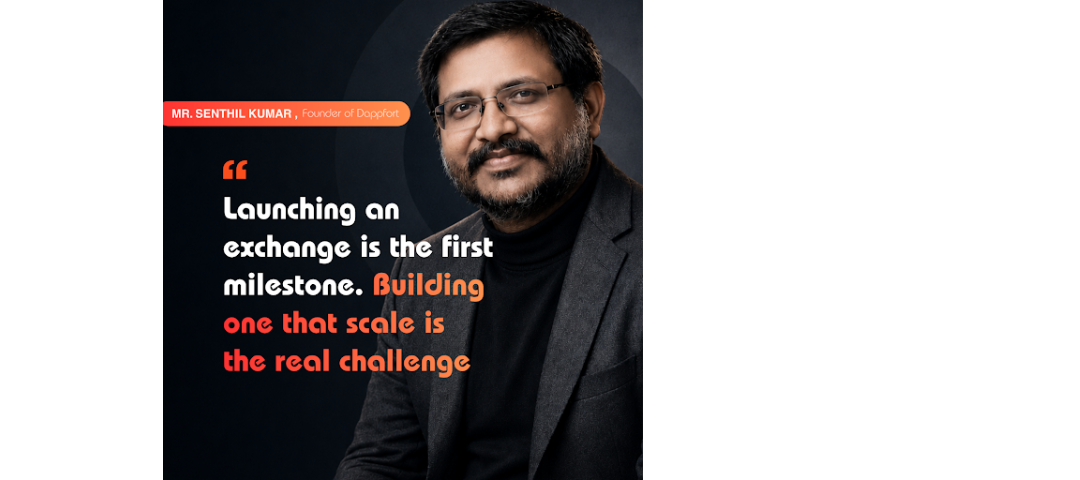
The cryptocurrency industry has reached a stage where launching an exchange is no longer the most difficult challenge.
Scaling it successfully is.
While many platforms enter the market with ambitious growth plans, only a small percentage sustain operational performance as user activity increases. Industry analysts frequently attribute these struggles to competition, market volatility, or user acquisition challenges.
However, according to Senthil Kumar, CEO of Dappfort, the underlying cause is often much simpler.
Infrastructure.
“Many exchanges are designed for launch rather than growth. The decisions made during development frequently determine how effectively a platform can scale months or years later,” says Kumar.
As digital asset markets continue to expand, infrastructure quality is becoming one of the most important differentiators between successful exchanges and those that struggle to maintain momentum.
Growth Creates Infrastructure Pressure
Every new user increases demand on exchange systems.
As activity grows, exchanges must manage:
- More trading orders
- Higher API traffic
- Increased wallet activity
- Greater database workloads
- Additional compliance processes
- Expanded monitoring requirements
Without scalable infrastructure, growth itself can become a source of operational risk.
Many exchanges discover these limitations only after user adoption begins accelerating.
The Hidden Cost of Poor Architecture
Infrastructure limitations rarely appear immediately.
A platform may perform adequately during launch while supporting a relatively small user base.
However, as transaction volume increases, weaknesses become more visible.
Common challenges include:
- Slower trade execution
- System downtime
- Delayed withdrawals
- Database bottlenecks
- Increased operational costs
These issues can negatively affect user trust and hinder growth momentum.
According to industry specialists, scalability should be considered a foundational business requirement rather than a future enhancement.
Infrastructure Recommendations for Founders
Businesses planning exchange launches should evaluate infrastructure from a long-term perspective.
Many Dappfort exchange experts recommend prioritizing:
- Modular architecture
- Scalable cloud environments
- High-performance matching engines
- Secure wallet systems
- Automated monitoring
- Disaster recovery planning
These investments often reduce future operational challenges while supporting sustainable growth.
The objective should not simply be launching an exchange but building a platform capable of supporting future expansion.
Engineering Decisions Shape Business Outcomes
Infrastructure decisions are often viewed as technical considerations.
In reality, they influence multiple business outcomes.
Scalable systems can improve:
- User experience
- Operational efficiency
- Security posture
- Cost management
- Regulatory readiness
As exchanges grow, the relationship between engineering quality and business performance becomes increasingly apparent.
The Future of Exchange Growth
Digital asset adoption continues to increase globally.
New trading products, institutional participation, and evolving market opportunities are expected to create additional demand for exchange services.
To capitalize on these opportunities, founders must think beyond launch requirements and focus on long-term operational sustainability.
Industry leaders such as Dappfort continue to encourage infrastructure-first development strategies that prepare businesses for future growth rather than immediate deployment alone.
Conclusion
The future of cryptocurrency exchanges will be shaped not only by innovation but also by engineering excellence.
While user-facing features remain important, infrastructure quality often determines whether an exchange can maintain performance, reliability, and scalability as demand increases.
According to Senthil Kumar, exchanges that invest in strong foundations today will be better positioned to compete in tomorrow’s increasingly sophisticated digital asset ecosystem.
As the industry matures, infrastructure may ultimately become the defining factor separating short-term success from long-term market leadership.